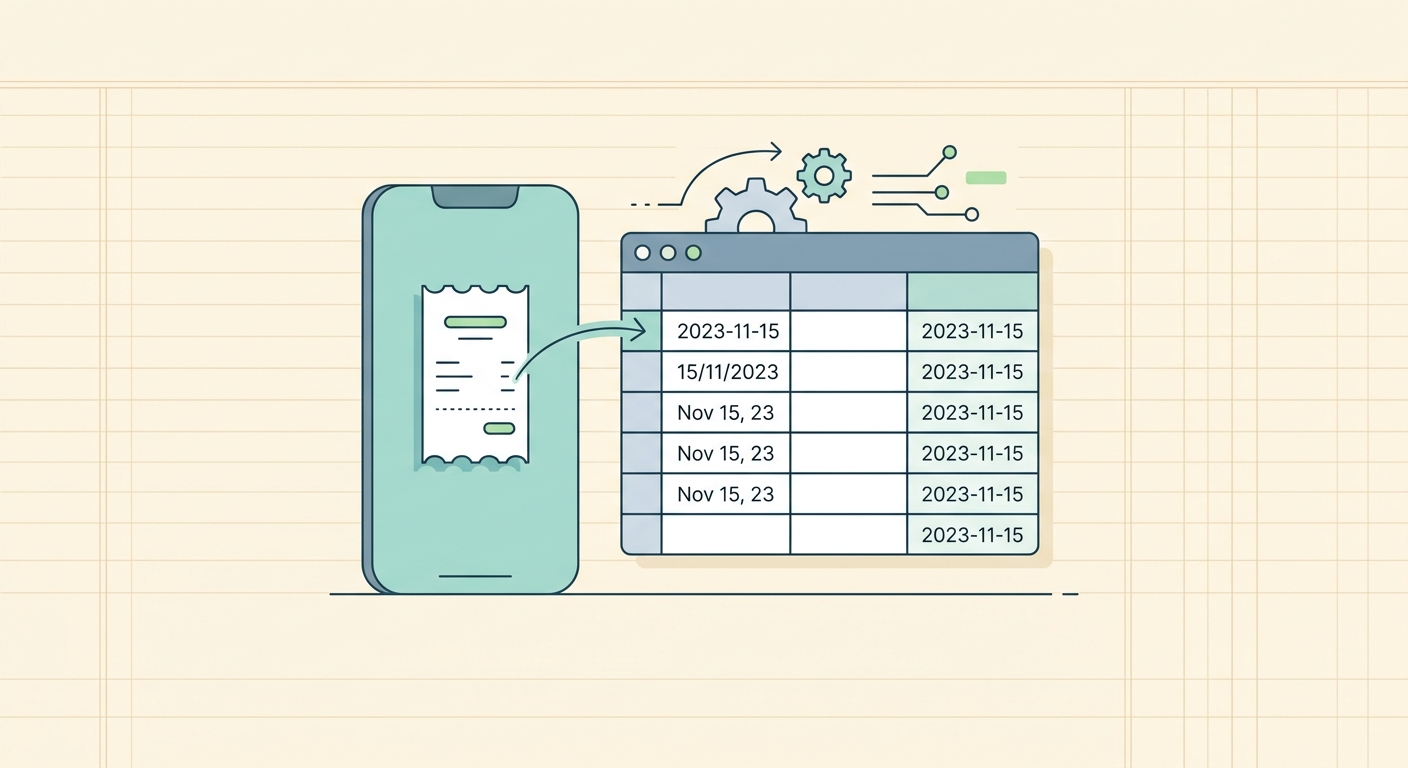
Mastering Expense Data: The Power of Date Format Standardization with SlipSheet
In the world of expense management, accuracy and consistency are paramount. Whether you are a small business owner, a freelancer, or an individual meticulously tracking personal finances, dealing with receipts is an unavoidable task. One of the most persistent headaches encountered when converting these physical or digital receipts into usable spreadsheet data is the sheer variety of date formats. From "MM/DD/YYYY" to "DD-MM-YY" and even "Month Day, Year," the inconsistencies can quickly turn a simple data entry task into a time-consuming manual correction marathon. This is precisely where the critical capability of date format standardization becomes indispensable, and it is a core strength of tools like SlipSheet.
Imagine a scenario where every date in your expense report is presented in a uniform, predictable manner, regardless of how it appeared on the original receipt. This level of consistency not only saves countless hours of manual editing but also drastically reduces the potential for errors, streamlines analysis, and ensures reliable reporting. SlipSheet is engineered to tackle this challenge head-on, transforming chaotic date information into perfectly standardized data points ready for your spreadsheets. Let us explore how SlipSheet achieves this and why it is a game-changer for anyone managing expenses.
The Challenge of Date Format Standardization in Expense Management
The problem with varied date formats extends beyond mere aesthetics; it has tangible operational consequences. When you collect receipts from different vendors, countries, or even just different dates, you are likely to encounter a multitude of date representations. One receipt might display "01/15/2023," another "15 Jan 23," and yet another "January 15th, 2023." While humans can easily interpret these, spreadsheet software and data analysis tools often struggle.
- Manual Correction Overload: Without proper date format standardization, every single entry might require manual adjustment to fit a consistent schema, leading to significant time wastage.
- Data Inaccuracy and Errors: Inconsistent formats can cause dates to be misinterpreted by software, leading to incorrect sorting, filtering, or calculations. For instance, "02/03/2023" could be February 3rd or March 2nd, depending on the assumed regional format, introducing costly errors.
- Reporting and Analysis Hurdles: Generating accurate monthly, quarterly, or annual reports becomes a nightmare when dates are not uniformly formatted. Trends are harder to spot, and aggregated data can be skewed.
- Compliance and Auditing Risks: For businesses, maintaining clear, auditable records is crucial. Inconsistent date formats can complicate compliance checks and make external audits more challenging.
These challenges highlight the urgent need for a robust solution that can automatically perform date format standardization, turning raw receipt data into clean, actionable information. SlipSheet provides precisely this relief, ensuring your expense data is always consistent and ready for use.
How SlipSheet Achieves Date Format Standardization
SlipSheet stands out by leveraging advanced technology to automatically detect, interpret, and standardize dates from a wide array of sources. When you upload a receipt photo or forward an email receipt to SlipSheet, its intelligent engine gets to work. It does not just perform optical character recognition (OCR) to extract text; it uses sophisticated algorithms trained on vast datasets to understand the context of the extracted numbers and words, specifically identifying dates.
The core mechanism revolves around intelligent parsing and pattern recognition. SlipSheet can identify common date patterns, even when they are partially obscured or presented in unconventional ways. Once a date is identified, it is then converted into a user-defined or default standard format, such as "YYYY-MM-DD" or "MM/DD/YYYY." This conversion happens behind the scenes, ensuring that by the time your data reaches your spreadsheet, every date entry is perfectly aligned.
This automatic date format standardization capability is a cornerstone of SlipSheet's value proposition. It ensures that the output you receive is not just accurate in terms of the date itself, but also consistent in its presentation, making your financial data immediately usable for analysis, reporting, and integration with other systems. The benefit is clear: less manual work, fewer errors, and more reliable financial insights.
Step-by-Step: Using SlipSheet for Consistent Date Outputs
Utilizing SlipSheet for impeccable date format standardization is remarkably straightforward, designed for efficiency and ease of use. The process is largely automated, requiring minimal intervention from the user, yet offering control where it matters.
- Upload Your Receipt: Begin by uploading your receipt. This can be done by taking a photo of a physical receipt with your smartphone, uploading an image file, or forwarding an email receipt directly to your unique SlipSheet address.
- SlipSheet Processes the Data: Once uploaded, SlipSheet's intelligent engine immediately begins processing. It employs advanced OCR to extract all relevant information, including the vendor, total amount, and crucially, the date of the transaction. During this phase, the date format standardization magic happens, as the system identifies the date and prepares it for conversion.
- Review and Confirm (Optional): In most cases, SlipSheet will accurately extract and standardize the date. However, for complete peace of mind, you can quickly review the extracted data within the SlipSheet interface. If a rare discrepancy occurs, you have the option to make a quick correction before export. This step reinforces user control without sacrificing automation.
- Export to Your Spreadsheet: With the data validated, including the now-standardized date, you can export your expense entries. SlipSheet integrates seamlessly with popular spreadsheet software, allowing you to download your data as a CSV or directly sync it, complete with all dates in your chosen consistent format.
The beauty of this process is that the complex task of date format standardization is handled automatically. You set your preferred output format once in your SlipSheet settings, and from then on, every receipt processed will conform to that standard, delivering clean, uniform data every time.
Technical Insights into SlipSheet's Date Parsing
The seemingly simple act of extracting a date from a receipt and standardizing its format involves a sophisticated blend of technologies. SlipSheet's engine combines cutting-edge optical character recognition (OCR), natural language processing (NLP), and machine learning (ML) models to achieve its high accuracy in date format standardization.
- Advanced OCR: The first step involves accurately extracting all text from a receipt image. SlipSheet's OCR goes beyond basic text recognition; it is optimized to handle various fonts, skewed images, low contrast, and even faded print, common challenges with real-world receipts.
- Contextual NLP: Once text is extracted, NLP algorithms analyze the surrounding words and numerical patterns. This helps SlipSheet differentiate between a date, a serial number, a part number, or a time stamp. For example, it understands that "1/2/2023" near a total amount is likely the transaction date, not a quantity.
- Machine Learning Models: SlipSheet employs trained ML models that have learned from millions of diverse receipts. These models recognize a vast array of date formats, including: "MM/DD/YY," "DD-MM-YYYY," "Month DD, YYYY," "DD Mon YYYY," and many regional variations. They also learn to handle ambiguities, such as distinguishing between "06/07/2023" (June 7th or July 6th) by considering common regional formats and other contextual cues on the receipt.
- Robustness and Error Handling: The system includes heuristics to cross-reference potential dates with other extracted information, enhancing accuracy. If a date is ambiguous, SlipSheet prioritizes common formats or flags it for potential user review, ensuring that date format standardization is not only automated but also reliable.
This multi-layered approach ensures that SlipSheet delivers exceptional performance in date format standardization, providing users with consistently formatted data ready for their financial workflows.
Real-World Applications: Common Use Cases for Standardized Dates
The benefits of consistent date format standardization ripple across numerous applications, making financial management more efficient and less prone to error. Here are some common use cases where SlipSheet's capability shines:
- Business Expense Reporting: Companies often require employees to submit expense reports with dates in a specific format for internal systems. SlipSheet automates this, ensuring all submitted receipts conform, speeding up reconciliation and reimbursement processes.
- Personal Budgeting and Financial Tracking: For individuals managing their personal finances, consistent date formats are crucial for accurate monthly spending analysis, tracking subscriptions, and monitoring financial health over time.
- Tax Preparation: When preparing for tax season, having all transaction dates in a uniform format simplifies the aggregation of expenses, making it easier to categorize deductions and comply with tax regulations.
- Auditing and Compliance: Businesses subject to audits or regulatory compliance benefit immensely from standardized date records. It demonstrates clear, consistent data management, facilitating smoother audit trails and reducing compliance risks.
- Project Cost Tracking: Project managers can use standardized dates to accurately track expenses against project timelines, providing clear insights into spending patterns and budget adherence for specific periods.
- Inventory and Supply Chain Management: While not directly expense-related, businesses tracking goods receipt dates or warranty periods can leverage SlipSheet's underlying technology to maintain consistent date records for operational efficiency.
In every scenario where chronological order and accurate time-based analysis are critical, SlipSheet's date format standardization capability proves to be an invaluable asset, transforming raw data into reliable information.
Advanced Customization and Troubleshooting Your Date Formats
While SlipSheet excels at automatic date format standardization, it also provides users with control and options for fine-tuning. Understanding these features can further enhance your data management experience.
- Setting Your Preferred Output Format: Within your SlipSheet account settings, you can typically select your desired default output date format. Options often include popular choices like YYYY-MM-DD, MM/DD/YYYY, DD/MM/YYYY, and more. Once set, all subsequent extractions will adhere to this standard, providing complete consistency without manual intervention.
- Handling Ambiguous or Incorrect Extractions: While SlipSheet's accuracy is high, no automated system is infallible. In rare cases, a date might be misidentified, or an ambiguous date (e.g., "01/02/23") might be interpreted differently than intended. If you notice an incorrect date during the review phase, SlipSheet's intuitive interface allows for quick and easy manual correction. You simply click on the date field and input the correct information, ensuring your final data is always precise.
- Leveraging User Feedback for Improvement: Every manual correction or feedback provided helps SlipSheet's machine learning models learn and improve. This iterative process continually refines the system's ability to perform date format standardization, making it smarter and more accurate over time.
By offering both robust automation and user-friendly customization, SlipSheet empowers you to maintain perfect control over your expense data, ensuring that every date is exactly where and how it should be in your spreadsheets. This dual approach guarantees reliability and adaptability for all your financial tracking needs.
The painstaking task of manually correcting inconsistent date formats is now a relic of the past, thanks to powerful tools like SlipSheet. By automating date format standardization, SlipSheet not only saves you valuable time but also enhances the accuracy and reliability of your financial records. Whether for personal budgeting, business expense reports, or tax preparation, consistent date data is a cornerstone of effective financial management. Experience the ease and precision of automated expense tracking.
Ready to transform your chaotic receipts into perfectly organized spreadsheet rows with standardized dates? Visit slipsheet.app today to learn more and start your journey towards effortless expense management.
FAQ
What is date format standardization?
Date format standardization is the process of converting various date representations from different sources into a single, consistent, and uniform format. This ensures all dates in a dataset follow the same structure, making them easier to sort, analyze, and use in spreadsheets or databases.
How does SlipSheet ensure dates are consistent?
SlipSheet uses advanced OCR and machine learning to automatically detect dates on receipt photos and email receipts, then converts them to a user-defined or default standard format. This intelligent parsing ensures all extracted dates conform to a consistent output for your spreadsheets.
Can I choose my preferred date format in SlipSheet?
Yes, SlipSheet allows users to select their preferred output date format within their account settings. Once set, all future receipt extractions will automatically standardize dates to your chosen format, providing complete consistency.
What if a date is extracted incorrectly by SlipSheet?
While SlipSheet boasts high accuracy, you can easily review and correct any misidentified or ambiguous dates within the SlipSheet interface before exporting your data. This ensures you maintain full control over the accuracy of your financial records.
Why is consistent date formatting important for expense tracking?
Consistent date formatting is crucial for accurate expense tracking because it prevents errors in data interpretation, streamlines sorting and filtering, simplifies financial analysis and reporting, and ensures compliance for audits. It transforms raw data into reliable, actionable insights.