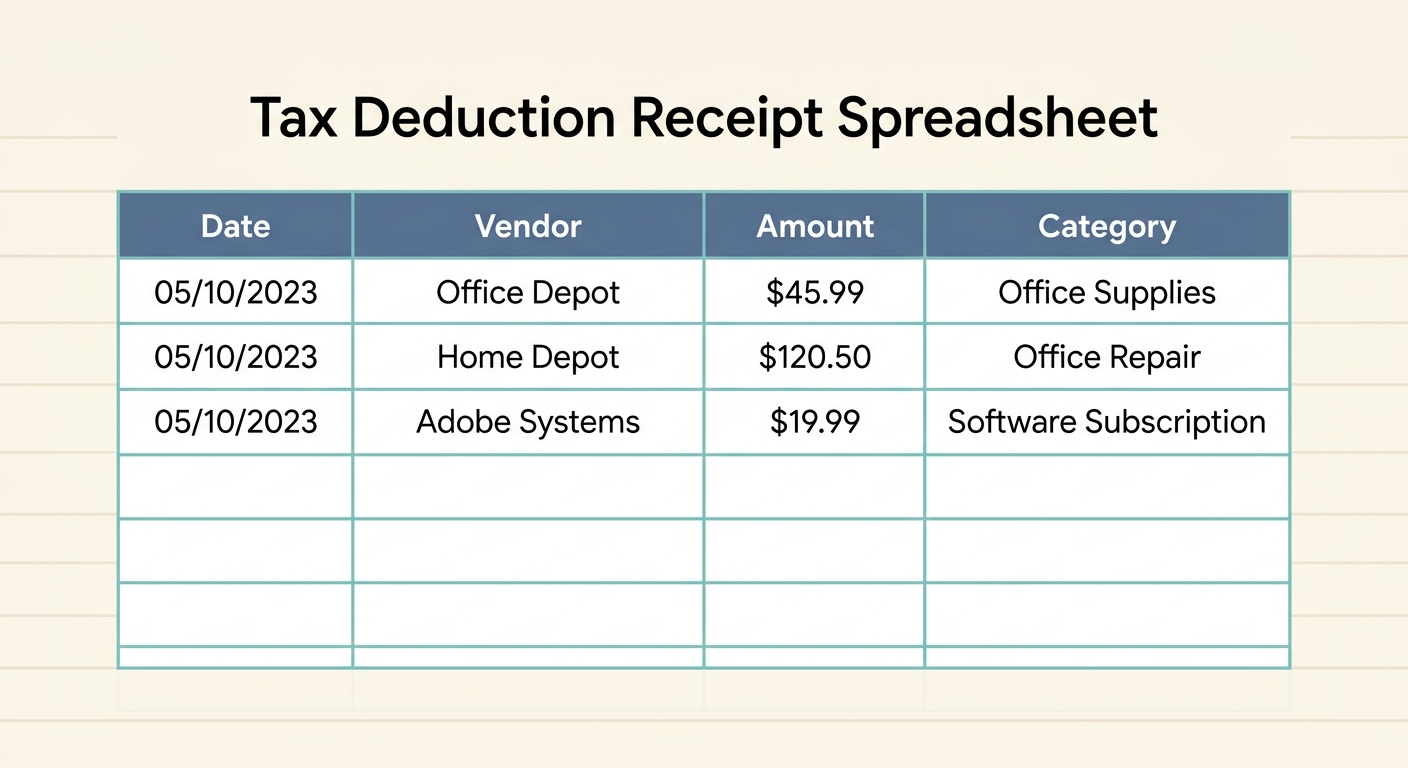
Managing your finances can often feel like a juggling act, especially when tax season rolls around. For individuals and businesses alike, maximizing tax deductions is a critical component of financial health. However, the process of organizing countless receipts, categorizing expenses, and ensuring audit-readiness can be daunting. This is where a robust tax deduction receipt spreadsheet becomes not just helpful, but absolutely essential. It serves as your central hub for all deductible expenses, transforming chaos into clarity and significantly simplifying your tax preparation.
Imagine a world where every eligible expense, from a business lunch to office supplies, is meticulously recorded and instantly accessible. No more frantic searches for faded paper receipts or digging through email archives. A well-structured tax deduction receipt spreadsheet provides this level of organization, ensuring you capture every possible deduction and avoid last-minute stress. While the idea of manual data entry might seem overwhelming, modern tools like SlipSheet are revolutionizing how effortlessly you can maintain such a vital record.
The Indispensable Tax Deduction Receipt Spreadsheet Template
At its core, a tax deduction receipt spreadsheet is a digital ledger designed to track all expenditures that qualify as tax deductions. It's more than just a list of numbers; it's a strategic tool that empowers you to take control of your financial records. For freelancers, small business owners, landlords, or anyone with deductible expenses, this template is your first line of defense against missed opportunities and potential IRS scrutiny. Its primary purpose is to consolidate all necessary information in an organized, searchable format, providing a clear narrative for each expense.
The benefits extend beyond just tax season. A well-maintained spreadsheet offers ongoing insights into your spending habits, helping with budgeting and financial forecasting throughout the year. It ensures consistency, reduces errors inherent in manual tallying, and provides a reliable audit trail. When an expense is recorded immediately and accurately, the chances of forgetting it or misplacing its corresponding receipt plummet, leading to a more comprehensive and accurate tax return.
Essential Fields for Your Tax Deduction Receipt Spreadsheet
To be truly effective, your tax deduction receipt spreadsheet needs specific columns that capture all relevant details for each transaction. This standardized approach ensures that no critical information is overlooked, making it easy for you, or your accountant, to understand the nature and legitimacy of each deduction. Here are the fundamental fields you should include:
- Date: The exact date the expense occurred. This is crucial for matching transactions to bank statements and for adhering to tax year regulations.
- Merchant: The name of the vendor or business from which the purchase was made. Clarity here prevents confusion and provides a clear point of reference.
- Deduction Category: This is perhaps one of the most important fields. It should align with IRS deduction categories, such as 'Office Supplies,' 'Travel,' 'Meals & Entertainment,' 'Utilities,' 'Professional Development,' or 'Vehicle Expenses.' Proper categorization is key to accurate tax filing.
- Amount: The total cost of the expense. This should be the final amount paid, including any taxes or fees.
- Tax: If applicable, a separate column for sales tax or other specific taxes paid can be very useful, especially for businesses that might recover or track these separately.
- Receipt File: A link or reference to the digital copy of the receipt. This is where modern tools like SlipSheet excel, allowing you to easily attach or link the actual receipt image or PDF directly to the spreadsheet row. This creates an irrefutable audit trail.
- Notes for Accountant: A free-form field for any specific context, purpose, or additional details about the expense that might be important for your accountant to know, such as the business purpose of a meal or the specific project an expense relates to.
Streamlining Your Workflow: How to Effectively Use Your Tax Deduction Receipt Spreadsheet
The true power of a tax deduction receipt spreadsheet comes from consistent and efficient use. Manual data entry, while possible, can be incredibly time-consuming and prone to errors. This is precisely where innovative solutions like SlipSheet become invaluable. Instead of manually typing each detail from every receipt, SlipSheet automates much of this process, transforming your approach to expense tracking.
With SlipSheet, you can simply snap a photo of a paper receipt with your phone or forward an email receipt. The tool then intelligently extracts key data points, such as the date, merchant, and amount, and populates these fields directly into your preferred spreadsheet format. This not only saves immense amounts of time but also significantly reduces the likelihood of transcription errors. You can then quickly add the deduction category and any specific notes, making the entire process efficient and accurate. Regular, ideally weekly or even daily, updates are key. Don't let receipts pile up; process them as soon as they occur to maintain an up-to-date and reliable record.
Tailoring Your Tax Deduction Receipt Spreadsheet: Customization Options
While the core fields are essential, a tax deduction receipt spreadsheet is a flexible tool that can be customized to suit your unique needs. Depending on your business model or personal financial structure, you might benefit from adding extra columns or utilizing advanced spreadsheet features.
Consider adding columns such as 'Payment Method' (e.g., credit card, debit, cash) for easier reconciliation with bank statements, 'Client/Project Name' for project-based businesses, or 'Reimbursable Y/N' if you track expenses that might be reimbursed by a client or employer. Utilizing spreadsheet features like data validation for deduction categories can ensure consistency, while conditional formatting can highlight large expenses or specific types of transactions. Pivot tables can be incredibly powerful for summarizing expenses by category, month, or merchant, providing quick insights into your spending patterns and making tax reporting a breeze.
Adapting the Tax Deduction Receipt Spreadsheet for Diverse Business Types
The beauty of a tax deduction receipt spreadsheet lies in its adaptability. While the core principles remain the same, different business structures will benefit from slightly varied approaches.
- Freelancers and Consultants: Might add a 'Project Code' or 'Client Name' column to track expenses directly attributable to specific projects, aiding in client billing and profitability analysis.
- Small Business Owners: Could include 'Department' or 'Cost Center' columns to track expenses across different operational areas, providing granular insights into departmental spending.
- Landlords and Property Managers: Would likely add a 'Property ID' column to delineate expenses for each property managed, categorizing maintenance, utilities, or repair costs per unit.
- E-commerce Sellers: Might track 'Inventory Purchase Date' and 'Supplier' in addition to standard expense fields to manage cost of goods sold more effectively.
Each adaptation serves to make the spreadsheet more relevant and powerful for that specific business type, ensuring all unique deductible expenses are captured and categorized correctly.
In conclusion, a well-maintained tax deduction receipt spreadsheet is an invaluable asset for anyone looking to simplify their tax preparation, maximize deductions, and ensure compliance. It transforms a potentially stressful annual task into a manageable, organized process. By consistently tracking your expenses with the right details, you build a strong foundation for financial clarity and audit readiness. The days of sifting through shoeboxes of paper receipts are over, especially with modern solutions that automate the heavy lifting.
Ready to transform your tax preparation process? Stop dreading tax season and start organizing smarter. Visit slipsheet.app today and discover how effortless managing your tax deduction receipt spreadsheet can be, turning receipt photos and email receipts into perfectly organized spreadsheet rows.
FAQ
Why is a tax deduction receipt spreadsheet important?
It is essential for accurate tax filing, maximizing deductions, and providing clear documentation to the IRS, which can prevent issues during an audit.
What are the most critical fields to include in my spreadsheet?
Date, Merchant, Deduction Category, Amount, and a link to the Receipt File are crucial for complete and defensible documentation of your expenses.
How often should I update my tax deduction receipt spreadsheet?
Ideally, you should update it regularly, even daily or weekly, to ensure accuracy, prevent forgotten expenses, and avoid a daunting year-end task.
Can a tax deduction receipt spreadsheet help me during an audit?
Absolutely, a well-maintained spreadsheet with linked digital receipts provides irrefutable proof of expenses, significantly easing the audit process and demonstrating due diligence.
How can SlipSheet simplify managing my tax deduction receipt spreadsheet?
SlipSheet automates data entry by converting receipt photos and email receipts into structured spreadsheet rows, saving significant time and ensuring the accuracy of your expense records.