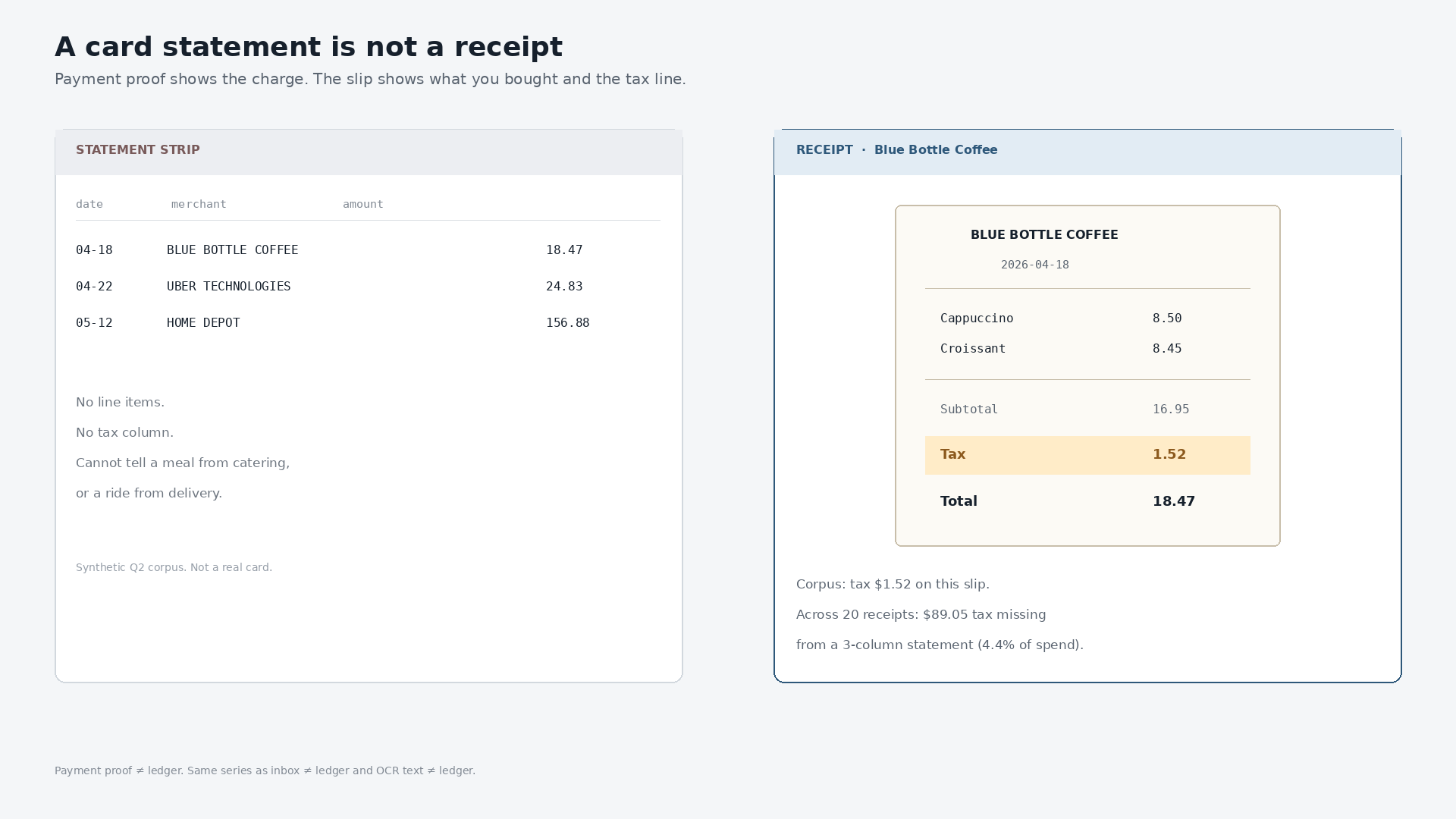
A card statement is not a receipt. It is payment proof: date, a mangled merchant string, and an amount. A ledger needs what you bought and the tax line. Same series as inbox ≠ ledger and OCR text ≠ ledger. Your CPA asked for the slip, not the Visa PDF.
We reuse the same 20 synthetic Q2 2026 receipts as the OCR piece. Not Brian’s real card. Ground truth on every slip: vendor, date, total, tax. Total spend $2,034.43. Numbers below are from that corpus, not invented.
What a statement shows
A statement strip looks like this. Merchant names below are the clean vendor labels from the corpus. Real Visa descriptors are messier (for example, something like SQ *BLUE BOTTLE — example only, not measured from a live feed).
| Date | Merchant | Amount |
|---|---|---|
| 2026-04-18 | Blue Bottle Coffee | 18.47 |
| 2026-04-22 | Uber Technologies | 24.83 |
| 2026-05-12 | Home Depot | 156.88 |
Three columns. No line items. No tax. You cannot tell a meal from catering, a ride from Uber Eats, lumber from a grill, or a monitor from a TV.
What the ledger needs
Same three slips, with the fields the sheet actually wants:
| Date | Vendor | Total | Tax |
|---|---|---|---|
| 2026-04-18 | Blue Bottle Coffee | 18.47 | 1.52 |
| 2026-04-22 | Uber Technologies | 24.83 | 2.15 |
| 2026-05-12 | Home Depot | 156.88 | 12.91 |
That tax column is the point. Across all 20 receipts, 14 have a tax line greater than $0. Together that is $89.05 of tax — 4.4% of the $2,034.43 spend — invisible on a date + merchant + amount statement. Six slips are untaxed, all SaaS: AWS, Notion, GitHub, Figma, Slack, Stripe.
Where the statement goes blind
Five restaurant receipts: Blue Bottle, Tartine, Zuni Cafe, Nopa, Sweetgreen. $346.48 spend, $28.51 tax. On the statement they are five merchant amounts. You cannot tell a coffee counter from a dinner or from catering.
Three rideshare charges: Uber $24.83 on 2026-04-22, Lyft $19.42 on 2026-05-09, Uber $41.19 on 2026-06-02. $85.44 spend, $7.40 tax. Uber is the only duplicate vendor in the set (19 unique vendors). The statement cannot tell a ride from food delivery under a similar brand string.
Home Depot $156.88 (tax $12.91): lumber vs a grill. Best Buy $214.99 (tax $17.70): a monitor vs a TV. Amount and merchant are not category.
Payment proof is still useful
Keep the statement. It proves the charge cleared. It is the wrong file when someone asks what you bought and how much tax sat on the slip. Reconciling receipts to bank lines is a different job from building the rows. This page is only the second one.
The slips become rows when you extract date, vendor, total, and tax into a sheet you own — CSV, Excel, or Google Sheets. OCR is how the digits leave the paper. It is the mechanism, not the product.
Slipsheet Starter is $5 a month for 250 receipts. Pro is $12 a month for 1,500. Fourteen-day trial, no card. Photo, PDF, or forward to receipts@slipsheet.app. You still glance at the totals. The Visa PDF stays payment proof.
A few straight answers
Is a credit card statement a receipt?
No. It is proof you paid. A receipt is proof of what was purchased, usually with a tax line.
Can I use the statement for expenses?
For “something charged,” sometimes. For “what and how much tax,” you need the slip or a ledger row built from it.
Why does tax matter if the total is on the statement?
The statement total mixes taxable and untaxed charges. In this corpus, $89.05 of tax never appears as its own column on a three-field statement strip.
Is this the same as bank-statement import?
No. Importing statement lines is reconciliation. This page is why those lines are not a substitute for receipt rows.