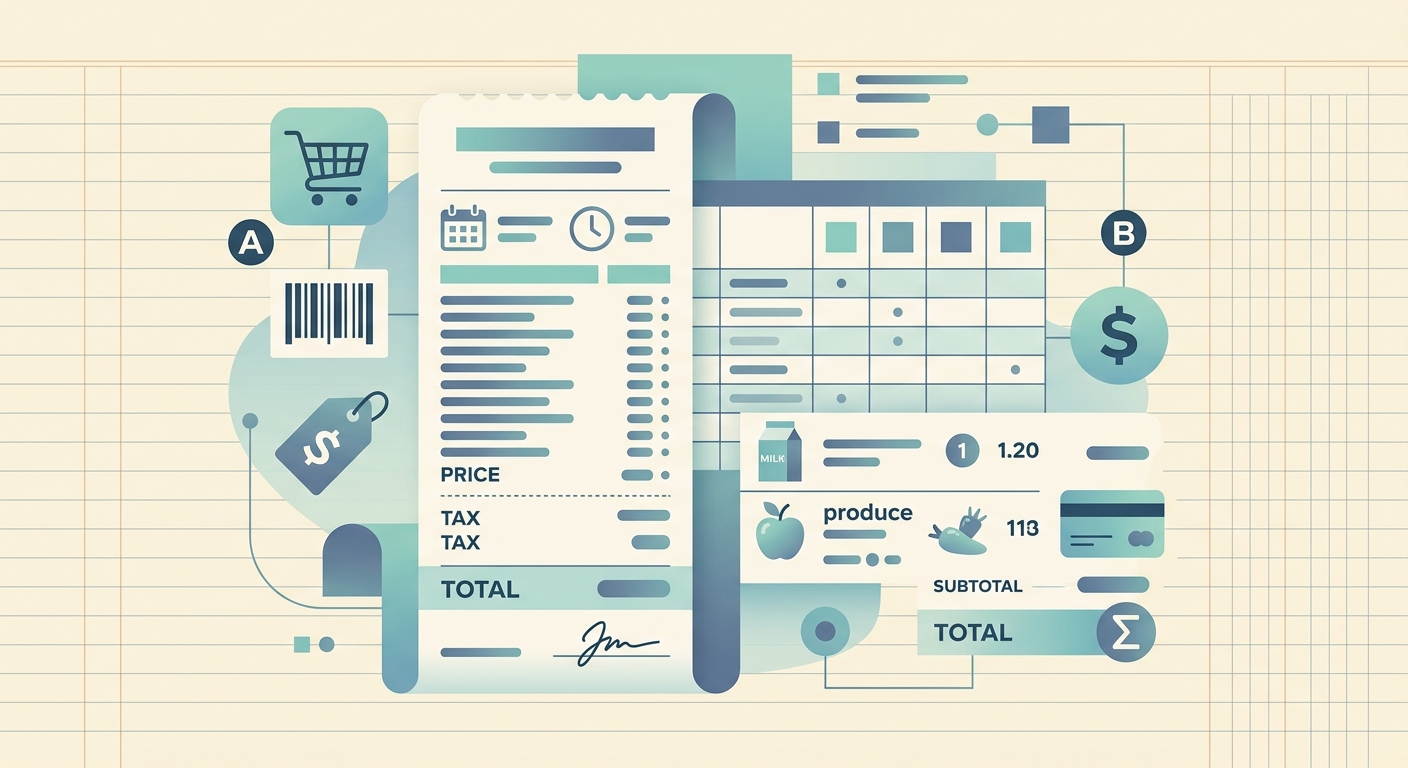
If you have ever stared at a crumpled strip of thermal paper wondering what half the abbreviations mean, you are not alone. Supermarket receipts are dense, inconsistently formatted, and full of line items most people never look at twice. But once you know how to read them, every receipt becomes a tidy record of what you bought, what you paid, what you saved, and what you can claim at tax time.
This guide walks through every section of a modern grocery receipt, from the header down to the bar code at the bottom. You will learn how to spot coupons, loyalty discounts, weighted items, and the difference between SKU and PLU codes. By the end you will be able to scan a receipt in seconds and know exactly which numbers matter for your bookkeeping.
What you need
- A few recent supermarket receipts (thermal paper, faded or fresh)
- A magnifying glass or your phone camera zoom for tiny print
- A spreadsheet, or a receipt scanner like SlipSheet that does the OCR for you
- Optional: a highlighter or pen to mark line items while you learn the layout
Step 1: Read the receipt header
The top of every receipt tells you where and when the purchase happened. Look for the store name and store number, the full street address, and the phone number. Below that you will see a transaction timestamp, usually formatted as MM/DD/YYYY HH:MM:SS, plus a register number, cashier ID, and a unique transaction ID. The transaction ID is the receipt's fingerprint: if you ever need a return or price adjustment, this is the number the store will ask for.
If the receipt includes a fuel discount or pharmacy transaction, that section often sits at the very top, before the line items begin.
Step 2: Decode the line items
Each purchased item takes one line. Most chains follow a similar pattern:
- Item description: a short, often abbreviated product name. "GV HL 2% MILK" means a grocery value half-gallon of 2 percent milk.
- Quantity: how many units you bought. A "1@" or "1 x" prefix means one unit at the listed price.
- Weight: produce and deli items show weight in pounds (lb) or kilograms (kg), followed by the price per pound.
- Price: the extended price for that line, after any per-item discounts.
Some receipts also include a SKU or PLU code at the end of the line. SKU (Stock Keeping Unit) is the store's internal identifier; PLU (Price Look-Up) is the standardized four or five-digit produce code. A five-digit PLU starting with 9, like 94011, means the item is organic.
Step 3: Separate subtotals, tax, and discounts
Below the line items, three numbers tell the story of what you actually paid:
- Subtotal: the sum of every line item before any discounts.
- Savings or discounts: a negative line, often prefixed with a minus sign or labeled "YOU SAVED." This includes manufacturer coupons, store coupons, loyalty discounts, and digital coupons.
- Tax: sales tax, sometimes broken out by category (food, non-food, prepared food). In some states groceries are tax-exempt; the receipt will show that explicitly.
The total at the bottom is what you actually paid: subtotal, minus discounts, plus tax. If you paid with a card, the card type (VISA, DEBIT) and last four digits usually appear here. Cash transactions also show the amount tendered and the change returned.
Step 4: Capture loyalty rewards and tender details
If you used a loyalty card, the bottom of the receipt often includes a points balance, fuel rewards earned, or a "REWARDS" section listing specific promotions applied. Digital coupons usually print a small summary like "4 digital coupons applied, $3.87 saved." EBT or SNAP-eligible purchases, if any, are split out separately under their own tender type so the store can reconcile federal benefit programs.
Step 5: Export the data into a spreadsheet
Reading is only half the job. Once you can parse a receipt, you want the data in a format you can search, sort, and total. SlipSheet reads supermarket receipts in one click and pulls merchant, date, line items, subtotal, tax, and total into a CSV or Google Sheet. No typing, no manual OCR cleanup. The result is an audit-ready log you can hand to your bookkeeper or import into QuickBooks at month-end.
Common mistakes to avoid
- Confusing the subtotal with the total. The subtotal excludes tax and discounts; the total is what left your wallet. Always log the total for expense tracking.
- Forgetting weighted items. A "0.86 lb @ $2.99/lb" line costs $2.57, not $2.99. If you log price-per-pound by mistake, your totals will drift.
- Missing negative lines. Coupons and loyalty discounts show as minus amounts. Double-check they are reflected in your CSV before you reconcile.
- Throwing away the receipt before scanning. Thermal paper fades fast, especially on a hot car dashboard. Scan or photograph it the same day you shop.
Once you can read a supermarket receipt confidently, every trip to the store becomes a clean data source. SlipSheet handles the scanning and the spreadsheet export so you can spend your time on the work that actually pays. Try SlipSheet free for 14 days.
FAQ
What is the difference between a SKU and a PLU code on a receipt?
A SKU is the store's internal product identifier, unique to that chain. A PLU is a standardized four or five-digit code used across the produce industry; a five-digit PLU starting with 9 indicates an organic item.
How do I find the actual amount I paid on a receipt?
Look for the line labeled 'TOTAL' at the bottom. That is the amount after subtotal, minus discounts and coupons, plus tax. Anything above it labeled 'SUBTOTAL' does not include tax.
Why do my line item prices not add up to the subtotal?
Weighted items, per-pound pricing, and percentage-off discounts often round differently than the displayed line items. Small discrepancies of a few cents are normal and not a sign of an overcharge.
Can I scan old or faded thermal receipts?
Yes, but scan or photograph them as soon as possible. Thermal paper fades quickly when exposed to heat or sunlight. SlipSheet still extracts most fields from faded receipts, but the highest accuracy comes from same-day scans.
What is the easiest way to export receipt data to a spreadsheet?
Use a receipt scanner like SlipSheet that captures the receipt with your phone camera and exports merchant, date, line items, tax, and total directly to CSV, Google Sheets, or Excel in one step.